
Workforce stability has become one of the most fragile elements of modern operations.
Instead of treating staffing as a static function, they are building resilient workforce models that can absorb shocks, adapt quickly, and maintain continuity under pressure. This shift reflects a broader move toward a workforce resilience strategy that prioritizes flexibility and preparedness.
At PSS, contingent staffing has become one of the most effective tools for workforce disruption management and staffing risk mitigation. When implemented strategically, it allows organizations to operate with confidence even in unpredictable labor conditions and supports long-term workforce continuity planning.
What Is Contingent Staffing & Why It Matters for Workforce Resilience
Contingent staffing refers to the use of workers who are not part of an organization’s permanent workforce. These workers are typically engaged on a temporary, contract, or project basis and are deployed to meet specific operational needs.
Today, contingent staffing is no longer just a temporary solution, it is a core component of a scalable workforce strategy designed to address volatility, uncertainty, and operational risk.
Common Forms of Contingent Staffing in Modern Workforce Models
Organizations today use contingent labor in several structured ways:
- Temporary workers supporting daily production or warehouse operations through a warehouse staffing agency
- Contract professionals with specialized technical or compliance-related skills
- Project-based teams assigned to defined initiatives such as facility expansions or system rollouts
- On-demand labor for absenteeism staffing solutions or sudden demand spikes
- Replacement labor during labor disputes or prolonged absenteeism
Why Contingent Staffing Has Become Essential for Workforce Resilience
Contingent staffing matters because it directly addresses the most common workforce risks organizations face today:
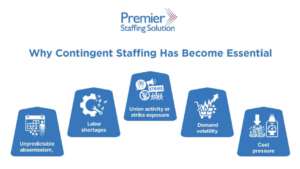
- Unpredictable absenteeism, driven by illness, burnout, or personal emergencies
- Labor shortages that make traditional hiring slower and less reliable
- Union activity or strike exposure that can disrupt operations without warning
- Demand volatility caused by market shifts or supply chain disruptions
- Cost pressure that makes overstaffing financially unsustainable
These challenges are pushing organizations to adopt proactive staffing risk management and resilience-driven workforce models.
Building a Workforce Contingency Plan for Staffing Risk Mitigation
One of the defining differences between resilient organizations and reactive ones is preparation. Companies that wait until a disruption occurs often face higher costs, limited options, and rushed decisions.
A structured workforce planning approach is critical to building an effective contingency framework.
Key Components of an Effective Workforce Contingency Plan
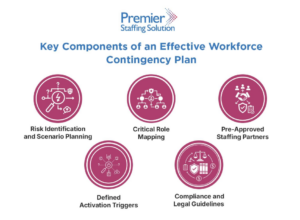
Risk Identification and Scenario Planning
Organizations must first identify where disruptions are most likely to occur. This includes analyzing historical absenteeism patterns, turnover rates, union exposure, seasonal demand spikes, and operational dependencies as part of broader labor disruption planning.
Critical Role Mapping
Not all roles carry the same operational risk. A contingency plan should clearly identify which positions are mission-critical and require immediate coverage to maintain workforce resilience.
Pre-Approved Staffing Partners
Waiting to identify a staffing partner during a crisis wastes valuable time. Resilient organizations establish relationships with experienced temp staffing agencies in advance.
Defined Activation Triggers
Clear thresholds should be set for when contingent staffing is deployed. Examples include absenteeism exceeding a certain percentage, production output falling below target, or customer backlog exceeding capacity.
Compliance and Legal Guidelines
Plans must account for labor laws, union labor compliance, safety requirements, and classification rules to avoid legal exposure during high-pressure situations.
How to Scale Up Quickly Using Contingent Staffing During Labor Disruptions
Labor disruptions rarely unfold gradually. More often, they escalate quickly, leaving little time to react.
Common Disruption Scenarios Organizations Face Today
- Sudden absenteeism requiring immediate absenteeism staffing solutions
- Labor strikes or union-related actions requiring labor strike staffing
- High turnover in physically demanding roles
- Simultaneous demand surges and staffing shortages
- Supply chain delays requiring schedule adjustments
How Contingent Staffing Enables Rapid Workforce Scaling
Instead of posting jobs, screening candidates, and onboarding over weeks, organizations can:
- Access pre-screened, job-ready workers
- Deploy labor within days rather than weeks
- Adjust shift coverage without restructuring permanent teams
- Scale workforce levels up or down as conditions change
This flexibility is central to building a scalable workforce strategy and maintaining operational continuity.
Labor Strike Staffing and High-Risk Workforce Events
When used appropriately and legally, contingent staffing can:
- Maintain essential operations and safety functions
- Reduce financial losses caused by prolonged shutdowns
- Support lawful continuity planning
- Protect customer commitments
Organizations in sectors like automotive staffing and manufacturing rely heavily on these strategies to avoid operational disruptions.
Avoiding Compliance Pitfalls with Temp & Contingent Staffing
While contingent staffing provides flexibility, it also introduces complexity. Without proper oversight, organizations may unintentionally expose themselves to compliance risks.
Common Compliance Risks in Contingent Workforce Models
Organizations using contingent labor often face challenges related to:
- Misclassification of workers
- Wage and hour compliance issues
- Co-employment concerns
- Safety training and certification gaps
- Union contract violations
- Inconsistent application of labor laws across jurisdictions
How to Manage Compliance Effectively in Contingent Staffing
Effective compliance management requires structure and expertise.
Organizations should:
- Partner with experienced temp staffing agencies familiar with regulated environments
- Clearly define employer responsibilities between internal teams and staffing partners
- Ensure all contingent workers receive required safety training
- Verify certifications and qualifications before deployment
- Maintain accurate documentation and reporting
Long-Term Benefits of Contingent Staffing for Workforce Resilience
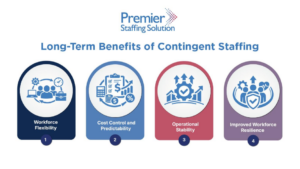
1. Workforce Flexibility Through Contingent Staffing
Contingent staffing enables organizations to adjust workforce levels as demand changes, without the disruption of layoffs or rapid hiring cycles. This flexibility is foundational to long-term workforce resilience.
2. Cost Control and Predictability with Scalable Workforce Strategy
By shifting a portion of labor from fixed to variable cost, organizations gain better financial control. This aligns labor spend with production output and supports staffing risk mitigation.
3. Operational Stability Through Workforce Continuity Planning
With access to contingent labor, organizations can maintain production levels even during disruptions. This stability protects customer relationships, delivery commitments, and brand reputation.
4. Improved Workforce Resilience with Contingent Staffing Models
Resilience is the ability to absorb shocks without collapsing. Contingent staffing strengthens resilience by providing backup capacity, redundancy in critical roles, and faster recovery from disruptions, key components of a workforce resilience strategy.
Conclusion: Building a Scalable Workforce Resilience Strategy
PSS provides strategic contingent staffing, workforce disruption management, and staffing risk mitigation services designed to help organizations maintain continuity, compliance, and confidence.
Contact PSS today to build a resilient, scalable workforce strategy that stands up to disruption and supports long-term operational success.
FAQ: Contingent Staffing, Workforce Planning, and Risk Mitigation
What is contingent staffing in 2026?
In 2026, contingent staffing is a strategic workforce model that uses temporary, contract, and project-based labor to manage uncertainty, mitigate risk, and maintain operational continuity. It plays a critical role in workforce resilience strategies, enabling organizations to respond quickly to disruptions while maintaining performance and compliance.