
Every manufacturer, warehouse operator, and logistics leader eventually faces the same high-risk moment.
Orders spike unexpectedly. A key customer accelerates delivery timelines. Several employees call out sick. A supplier delay ripples through the operation. Suddenly, production slows, fulfillment falls behind, and leadership is forced into damage-control mode.
The biggest issue isn’t demand, it’s workforce readiness.
This guide breaks down how just-in-time staffing (JITS staffing) works, why it has become essential in 2026, and how organizations use it to protect production continuity, warehouse performance, and delivery reliability, even during unpredictable conditions. For operations leaders managing warehouse logistics staffing and manufacturing teams, JITS has quickly become one of the most effective scalable workforce solutions available.
What Is Just-in-Time Staffing (JITS)?
Just-in-time staffing is a workforce strategy that aligns labor supply directly with operational demand, only deploying workers when and where they are needed, instead of maintaining excess headcount year-round.
Rather than relying exclusively on permanent staff or scrambling during emergencies, JITS staffing allows organizations to:
- Scale labor up or down based on real-time demand
- Fill sudden labor gaps without lengthy recruitment cycles through rapid staffing strategies
- Maintain productivity without long-term payroll commitments
- Reduce idle labor costs during slower periods
- Preserve production continuity during disruptions
Many organizations combine just-in-time staffing with contingent staffing programs to ensure workforce flexibility without compromising operational performance.
Why Workforce Disruptions Are the #1 Operational Risk Today
Operational leaders are facing a workforce environment that is more volatile than ever.
Key challenges include:
- Higher employee turnover, especially in warehouse logistics staffing roles
- Unpredictable demand cycles driven by e-commerce, global supply chains, and customer expectations
- Labor shortages within the skilled trades workforce and technical roles
- Rising labor costs, making overstaffing financially unsustainable
- Pressure to meet strict delivery timelines and SLAs
In manufacturing and logistics environments, even short disruptions can cascade into:
- Missed delivery windows
- Production bottlenecks
- Overtime overruns
- Safety risks due to overworked teams
- Customer dissatisfaction and contract penalties
These risks are why companies increasingly rely on just-in-time staffing and surge staffing to stabilize operations when workforce disruptions occur.
Why JITS Matters for Manufacturers & Logistics Providers
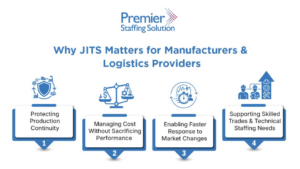
1. Protecting Production Continuity with Just-in-Time Staffing
Production continuity is the backbone of operational success.
JITS staffing protects continuity by:
- Ensuring coverage during absenteeism or turnover
- Providing backup labor during equipment downtime recovery
- Supporting ramp-ups for new production runs
- Preventing bottlenecks caused by understaffed shifts
In industries such as automotive staffing, logistics, and manufacturing, the ability to maintain production continuity often determines whether companies meet delivery commitments or fall behind.
2. Managing Cost Without Sacrificing Performance Through JITS Staffing
Labor is one of the largest operational expenses. Traditional models force leaders into a lose-lose choice:
- Overstaff to stay prepared — and waste payroll
- Understaff to control costs — and risk downtime
Just-in-time staffing eliminates that tradeoff.
Cost advantages include:
- Reduced idle labor during slow periods
- Lower overtime dependency
- No long-term benefits or fixed payroll commitments for temporary demand
- Predictable staffing costs tied directly to production volume
Organizations that partner with an experienced warehouse staffing agency or temp staffing agency can implement JITS strategies without increasing administrative burden.
3. Enabling Faster Response to Market Changes with Rapid Staffing
Customer expectations in 2026 demand speed and flexibility.
JITS allows organizations to:
- Respond quickly to last-minute order increases
- Adjust labor when demand shifts unexpectedly
- Maintain service levels during supply chain disruptions
- Support emergency staffing needs during production recovery
Many companies also use surge staffing models alongside just-in-time staffing to ensure rapid response during unexpected demand spikes.
4. Supporting Skilled Trades & Technical Workforce Needs
Skilled trades and technical positions require experience, certification, and safety awareness.
Modern JITS staffing strategies increasingly include access to a qualified skilled trades workforce, such as:
- Skilled machine operators
- CNC machinists
- Maintenance technicians
- Forklift and heavy equipment operators
- Specialized warehouse roles
For manufacturing and automotive staffing environments, access to experienced workers through contingent staffing and rapid deployment models helps maintain operational stability.
When to Activate JITS: Common Operational Scenarios
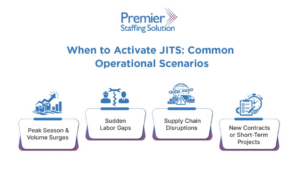
Peak Season & Volume Surges in Warehouse Logistics Staffing
Common in:
- Warehouse logistics staffing environments
- E-commerce fulfillment
- Manufacturing cycles tied to seasonal demand
These situations often require rapid staffing capabilities that only flexible workforce models like just-in-time staffing can provide.
Sudden Labor Gaps and Emergency Staffing Response
Examples include:
- Unexpected resignations
- Illness outbreaks
- No-shows on critical shifts
- Delayed new-hire start dates
These disruptions frequently trigger emergency staffing deployment through trusted staffing partners.
Supply Chain Disruptions and Contingent Staffing Flexibility
When upstream delays or changes affect production schedules, JITS staffing provides flexibility to adapt staffing without shutting down operations.
New Contracts or Short-Term Projects Requiring Rapid Staffing
Winning a new client or contract often requires rapid scaling. Just-in-time staffing enables fast ramp-ups while leadership evaluates long-term workforce needs.
Checklist: Is Your Operation JITS-Ready?
Use this checklist to evaluate readiness:
Workforce Planning for Flexible Production Capacity
- Clear understanding of peak vs baseline staffing needs
- Defined triggers for activating JITS staffing strategies
Staffing Infrastructure for Rapid Workforce Deployment
- Access to a pre-qualified labor pool
- Rapid onboarding processes
- Background checks and compliance handled externally
Operational Alignment for Temporary Workforce Integration
- Supervisors trained to integrate temporary staff quickly
- Clear job documentation and SOPs
- Safety training protocols ready on day one
Partnership Readiness for Emergency and Surge Staffing
- A staffing partner with industry experience
- Proven ability to deploy within 48–72 hours
- Transparent communication and accountability
Organizations often work with a temp staffing agency or specialized warehouse staffing agency to ensure these systems are already in place.
Emergency & Surge Staffing: The Critical Backup Layer
Surge staffing is a specialized extension of just-in-time staffing designed for unexpected, high-pressure situations.
Emergency staffing is activated when:
- Demand spikes without warning
- Backlogs threaten customer commitments
- Production lines must recover quickly
- External events disrupt normal staffing levels
Benefits of surge staffing include:
- Immediate labor deployment
- Short-term workforce scalability
- Reduced pressure on permanent teams
- Faster recovery from operational shocks
Partnering With the Right JITS Staffing Agency
A trusted JITS staffing partner should provide:
Deep Talent Access Across Skilled Trades and Logistics
- Warehouse & logistics professionals
- Experienced skilled trades workforce specialists
- Manufacturing and production specialists
Speed & Reliability Through Rapid Staffing Deployment
- Rapid staffing deployment timelines
- Backup candidate pipelines
- Proven emergency staffing response capability
Compliance & Safety in Industrial Staffing Environments
- OSHA-aligned safety standards
- Background checks and certifications
- Industry-specific compliance expertise
Operational Understanding of Manufacturing & Logistics Workflows
- Familiarity with manufacturing and logistics environments
- Ability to anticipate staffing risks
- Proactive workforce planning, not just reactive placements
Conclusion: Workforce Agility Is No Longer Optional
In 2026, companies that maintain production continuity are not the ones with the largest teams, they are the ones with the most flexible workforce strategies.
Just-in-time staffing, surge staffing, and contingent staffing models allow organizations to align labor with real-time operational demand while maintaining efficiency and cost control.
When labor aligns with demand, operations stay resilient, even when everything else changes.
Contact PSS today to build a JITS staffing or surge staffing strategy that protects your operations and keeps your business moving forward.
FAQs About JITS Staffing
How does JITS staffing reduce downtime?
By deploying just-in-time staffing resources before labor gaps disrupt workflows. Organizations can access qualified workers quickly through rapid staffing and emergency staffing models, allowing production lines and warehouse operations to continue without interruption.
What industries benefit most from JITS?
Industries that rely heavily on production continuity and flexible labor models benefit the most from just-in-time staffing, including:
- Manufacturing
- Warehouse and logistics operations
- Automotive production environments
- Skilled trades and technical industries
These sectors frequently rely on warehouse logistics staffing, contingent staffing, and scalable workforce strategies to maintain operational performance.