
Why Staffing Is the Hidden Lever Behind OTIF Performance?
Every customer remembers the delivery that missed the promised time. Underneath that untimely arrival often sits a staffing failure—unfilled roles, absenteeism, labor shortages—that break the rhythm of operations and damage reputation. Psychologically, customers judge brands not only on what they receive, but when, and trust erodes after just one delivery miss. Internally, employees stretched thin feel less engaged, more error-prone, and burn out quickly.
Internally, understaffed teams experience fatigue, disengagement, and higher error rates. This is why on-time delivery performance and OTIF staffing impact are inseparable. Without the right staffing model in place, OTIF metrics decline rapidly—even in otherwise well-run operations.
Why Labor Issues Lead to Missed SLAs and OTIF Failures
SLA Foundations & Staffing Pressure
Service Level Agreements are commitments—like delivering 95% of shipments by the promised date. Meeting them demands operational predictability. But labor disruptions—unanticipated absentee spikes, protracted hiring pipelines, or union disputes—inject volatility. When labor is lean, response times lag, quality drops, and missed windows multiply. As providers in MSP environments know, under‑resourced teams lead to slower case resolution and rising SLA breaches.
External Labor Shocks & Skills Gaps
Global shortages in warehouse, logistics, and skilled trades have worsened in the last two years. Harvard Business Review reported shortages affecting the entire supply‑chain continuum—from sourcing to delivery. Without qualified staff on hand, operations slow and OTIF erodes.
Internal Staffing Inefficiencies
Even when headcount is nominally full, poor internal processes—slow time‑to‑fill, low-quality candidates, high turnover—lead to underperforming teams. Staffing KPIs like time‑to‑hire, fill rate, and retention interlock with customer deadlines and output quality.
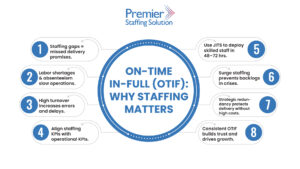
Filling Staffing Gaps Before They Hurt Your Customer Reputation
Just-in-Time Staffing (JITS): Precision When You Need It
Premier Staffing Solution’s Just-in-Time Staffing system (JITS) is built to respond to urgent needs with precision. JITS enables rapid deployment—typically within 48–72 hours—anchored by pre‑vetted, role‑ready professionals in logistics and skilled trades. When a supplier stalls or order volume spikes, JITS plugs the gap fast, restoring workflow and preserving OTIF.
When order volume spikes or suppliers stall, JITS restores workflow quickly, protecting production continuity staffing and OTIF performance.
Crisis-Proofing via Emergency & Surge Staffing
In situations like labor strikes, absenteeism surges, or sudden production slowdowns, PSS deploys emergency staffing solutions and surge staffing to prevent backlogs and reputation damage. These deployments normalize flow again before customer commitments slip. Using pre-scripted HR/PR templates and onsite workforce management, PSS clients maintain operational stability even during workforce crises.
Pre‑Emptive Planning: Avoiding Reactionary Hiring
Waiting until increasingly frequent early warning signs—like rising absenteeism or late shipments—is too late. Premier advocates for pre‑planned JITS triggers built into quarterly operations reviews: thresholds on coverage gaps, line-speed drops, or missed shifts. When triggers are hit, extra staff activate seamlessly Premium Staffing Solution. This level of preparedness preserves OTIF even before disruption becomes visible to customers.
Staffing KPIs That Align with Operational and OTIF KPIs
To ensure labor strategy supports delivery metrics, staffing KPIs must map directly onto operational goals:
- Time‑to‑Fill tracks how many days it takes to fill roles; long fill times mean gaps in coverage and missed deliveries.
- Fill Rate measures percentage of open roles filled; low rates predict workforce shortfalls and routing delays.
- Retention Rate & Quality of Hire, using manager satisfaction and performance metrics, speak to long‑term reliability and effectiveness, crucial for meeting SLAs consistently.
- Turnover and absenteeism, tracked weekly, help forecast stress zones before OTIF drops.
- Submitting timesheets on time signals administrative efficiency and billing alignment with operational throughput (often overlooked operational staffing KPI.
Integrating these staffing KPIs with OTIF dashboards helps identify root causes early—whether it’s skill shortages, pipeline delays, or candidate mismatches—and allow course correction before customer SLAs slip.
Can You Staff for Redundancy Without Losing Profit?
It’s a delicate balance: staffing with slack (i.e., redundancy) costs more, yet under-staffing costs even more when deliveries miss and reputation suffers. Here’s how to fine-tune:
Lean but Resilient Staffing
Instead of fixed extra headcount, use contingent staffing—like tapping PSS’s flexible temp-to-perm or surge staffing only when needed. This gives buffer capacity on demand, not a fixed cost burden.
Smart Workforce Mapping
Analyze peak demand seasons, typical absentee spikes, and production bottlenecks. Buffer strategically around those points with pre‑approved contingency demand plans tied into JITS triggers.
Cost-Benefit & ROI Modelling
Comparing staffing investment against penalties, lost revenue, and customer churn reveals the true value of redundancy. Staffing models for OTIF improvement consistently outperform reactive hiring strategies in both cost and reliability.
Just-in-Time Staffing (JITS) as a Tool to Protect OTIF Metrics
From Pipeline to Deployable Talent
Premier’s JITS is built on a pre‑qualified talent pipeline: skills-screened professionals ready within hours, not days, across forklift operation, warehousing, and skilled trades. That speed matters when deliveries hang in the balance.
Real-World Case Examples
In one example, a logistics provider won a last-minute contract, faced a 40% surge in outbound volume, and PSS scaled their staffing team by 50 workers in under 3 days—protecting OTIF and locking in a long-term client relationship.
Integration with Continuous Ops Planning
When JITS becomes part of routine workforce planning, staffing transforms from a reactive fix into a strategic lever—supporting staffing scalability, SLA stability, and long-term delivery reliability.
Conclusion: Staffing as a Strategic Driver of OTIF Performance
Staffing isn’t merely HR’s problem—it’s the structural support of delivery performance. Gaps, delays, and burnout aren’t just internal concerns: they manifest externally as missed SLAs, unhappy clients, and lost credibility.
- Labor issues drive SLA failure via unfilled shifts, slow response, and weakened throughput.
- Proactive planning and Just‑In‑Time systems like PSS’s JITS mitigate disruption and reinforce on‑time delivery.
- Staffing KPIs aligned with operational KPIs make it possible to detect risk before failure.
- Strategic redundancy using contingency staffing provides resilience without permanently inflated labor costs.
- JITS protects OTIF by offering fast, skill‑matched deployments backed by a vetted talent network.
In today’s logistics-driven economy, consistently meeting OTIF defines whether operations can scale. With the right flexible staffing partner and rapid staffing framework, organizations can protect customer trust while remaining lean, agile, and profitable.
FAQs: Staffing, OTIF, and Delivery Performance
1. How does staffing impact OTIF (On-Time In-Full) delivery rates?
Staffing directly affects each stage of the supply chain—from production speed to warehouse turnaround and delivery accuracy. Understaffing or low-quality hires lead to missed timelines, errors, and reduced throughput, all of which lower OTIF scores.
2. What are the most common staffing issues that lead to missed SLAs?
Common causes include high absenteeism, skill mismatches, long time-to-fill roles, unplanned labor shortages, and poor retention. These disrupt schedules, delay shipments, and break SLA commitments.
3. Can companies prevent delivery delays through staffing solutions?
Yes. With proactive staffing models like Just-in-Time Staffing (JITS), companies can rapidly deploy trained talent during spikes or shortages—preventing disruptions before they affect customers.
4. What is Just-in-Time Staffing and how does it work?
Just-in-Time Staffing is a rapid-response labor solution that deploys pre-qualified, job-ready workers within 48–72 hours. It allows businesses to scale their workforce on demand without permanent cost increases.
5. How does Premier Staffing Solution help with on-time delivery?
Premier Staffing Solution offers emergency and JITS support for logistics, warehousing, and production roles. Their vetted candidate pool, fast deployment, and on-site management help maintain workforce continuity and protect delivery timelines.