
Why Labor Planning Is Critical for Launch Success
Launching a new product is often a company’s most critical growth moment. It is a high‑pressure phase where timing, execution, and resource allocation can make or break success. While companies invest heavily in product development and marketing, workforce planning and product launch staffing are often overlooked until it becomes a crisis.
Psychology research shows that under‑resourced teams suffer from burnout, lower cognitive performance, and higher error rates. Conversely, overstaffing leads to unnecessary costs and disengagement due to idle time. This is where contingent staffing, surge staffing, and rapid hiring strategies play a pivotal role in protecting launch timelines.
According to Harvard Business Review, companies that implement structured workforce planning achieve up to 10 percent higher productivity and reduce labor costs by 20 to 25 percent over five years. These figures reinforce that labor planning, supported by a temp staffing agency or national staffing network, is not just a support function—it is a critical success factor for any launch.
In this guide, we will explore why labor planning is essential for launch success, the staffing roles involved in various phases, how surge staffing and emergency staffing solutions prevent delays, and the benefits of working with a scalable staffing solutions provider like Premier Staffing Solution. We also share real-world case studies and practical tips to build a flexible workforce model that supports both ramp-up and ramp-down needs.
Why Labor Planning Is Critical for Launch Success
A successful product launch requires a synchronized team effort across multiple functions, from production and logistics to marketing and customer support. Poor staffing decisions can derail timelines, inflate costs, and harm customer satisfaction.
Demand forecasting is central to effective workforce capacity expansion. By anticipating how many products will be needed, how fast they will move, and what level of support will be required, companies can proactively plan their workforce. This avoids the two most common problems—being understaffed on launch day or having too many idle employees after the initial hype.
There is also a psychological dimension to consider. Launch periods are stressful and intense. Employees working long hours under pressure without enough support face higher burnout rates and reduced decision‑making ability. A well-planned labor strategy that blends just-in-time staffing and rapid staffing reduces stress, improves morale, and enables teams to focus on quality execution.
Staffing Roles Involved in Launch Phases
Different launch phases require different roles. Before the launch, strategic planners, HR analysts, and hiring managers work on demand forecasts and recruitment strategies. During the build‑up phase, recruiters and onboarding specialists drive rapid hiring using pre-vetted talent pools.
On launch day, operations staff, logistics teams, production workers, and customer support agents become the backbone of execution. After the initial rush, transition leads and HR coordinators step in to manage performance evaluation and scale the workforce down to sustainable levels.
Working with a partner such as Premier Staffing Solution ensures that product launch staffing needs are met quickly through contingent staffing models supported by a national staffing network.
How to Avoid Delays with Surge Staffing
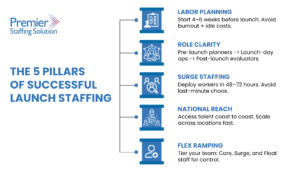
Even the most prepared companies can face unexpected demand spikes or staffing gaps. Surge staffing is the solution to these problems. A surge staffing partner can provide qualified workers on short notice, often within 48 to 72 hours.
A real‑world example is Buddy’s Plant Plus, a fertilizer manufacturer that faced an urgent surge order. The company needed 40 additional associates for a second shift, and a staffing partner delivered the required workforce within 48 hours. The staff met performance metrics almost immediately, ensuring on‑time delivery and preventing a major business loss.
Premier Staffing Solution specializes in surge staffing and emergency staffing solutions, delivering vetted talent rapidly while reducing administrative burden and compliance risk.
Benefits of Working with a National Staffing Network for Rapid Hiring
A national staffing network provides access to a broad and diverse talent pool, enabling rapid hiring for product launches across multiple locations. This scalability is critical for organizations launching regionally or nationally.
Staffing partners also manage payroll, onboarding, and compliance—critical during high-pressure launches. Many organizations rely on warehouse staffing agencies and manufacturing staffing support to ensure qualified labor is available exactly when needed.
By leveraging scalable staffing solutions, companies gain flexibility, cost control, and workforce resilience without compromising timelines.
Creating a Flexible Ramp‑Up and Ramp‑Down Model
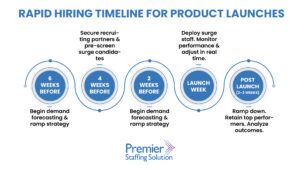
To optimize costs and performance, companies need a staffing plan that allows teams to adjust staffing levels using workforce disruption management principles. The first step is to forecast demand well in advance and build a tiered workforce model. Permanent staff form the core, surge staff fill temporary gaps, and floating staff provide backup coverage.
Regular checkpoints, thirty, fourteen, and three days before launch, allow teams to compare forecasts with real‑time demand and make necessary adjustments. Flexible contracts with short notice periods enable companies to ramp down without long‑term liabilities.
Cross-training surge staff across roles enhances adaptability. When demand shifts, workers can redeploy instead of becoming idle, supporting a flexible workforce model that balances cost and productivity.
Case Study: How Tech Giants Use Scalable Hiring
Technology leaders such as Google and Amazon rely on predictive analytics and pre-built talent pipelines to scale rapidly. One major tech company doubled its engineering workforce in a year while maintaining productivity through temporary workforce solutions and rapid staffing models.
While most product launches do not require that scale, the same principles apply: data-driven forecasts, workforce tiering, and partnerships with a temp staffing agency that understands launch dynamics.
Conclusion
A successful product launch is as much about people as it is about the product itself. Contingent staffing, surge staffing, and rapid hiring protect timelines, reduce burnout, and improve execution quality.
Organizations that invest in product launch staffing strategies gain a competitive edge by minimizing risk, maintaining morale, and avoiding costly delays.
If you are preparing for a new product rollout, now is the time to build a staffing strategy that matches your goals. Download our Launch Staffing Checklist and get in touch with Premier Staffing Solution to learn how a tailored surge staffing plan can ensure your launch success.
FAQs
When should I start planning for surge staffing before a launch?
It is best to begin planning four to six weeks before the launch. Checkpoints at thirty, fourteen, and three days before the launch allow you to activate or adjust your ramp plans.
How quickly can surge staff be deployed?
Most staffing agencies can deploy qualified workers within forty‑eight to seventy‑two hours. The Buddy’s Plant Plus case study is proof that surge staffing can make a difference almost overnight.
Is surge staffing more expensive than traditional hiring?
The hourly rates may be higher, but the savings on recruitment costs, compliance, and time‑to‑hire offset these expenses. It also reduces the risk of revenue loss due to missed deadlines.
How do I ensure quality when hiring quickly?
Partner with a national staffing network that pre-screens candidates and tracks performance metrics from day one.
Can surge staff become permanent employees?
Yes. Many companies convert high‑performing surge staff into permanent employees after the launch period.