Industrial and warehouse operations are no longer dealing with simple hiring challenges.
Supply chains are under scrutiny for resilience and reliability. Yet across all of these environments, one problem remains consistent: finding, deploying, and retaining the right workforce at the right time.
At PSS, this shift is already evident. Industrial leaders are moving away from rigid staffing models and toward flexible, scalable industrial staffing services that can support modern manufacturing staffing, growing warehouse labor demand, and evolving operational needs in 2026 and beyond. These changes are shaping the future of industrial staffing and redefining how organizations approach workforce strategy.
Why Industrial Staffing Services Are Evolving in Manufacturing and Logistics
Industrial staffing is evolving because the operational environment has fundamentally changed. The workforce models that worked a decade ago can no longer keep pace with today’s realities.
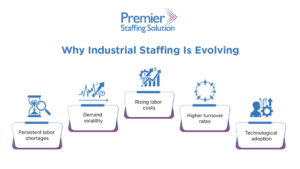
Several structural factors are driving this evolution:
- Persistent labor shortages are affecting manufacturing staffing, warehousing, and skilled trades staffing simultaneously, making traditional hiring slower and less reliable.
- Demand volatility has increased due to e-commerce growth, shorter customer lead times, and global supply chain disruptions that require stronger supply chain labor support.
- Rising labor costs have made overstaffing financially unsustainable for most organizations.
- Higher turnover rates are forcing companies to refill roles more frequently, increasing recruitment fatigue.
- Technological adoption is changing job requirements faster than internal training programs can adapt.
These challenges are accelerating industrial staffing trends that prioritize flexibility, scalability, and operational responsiveness.
Trends in Flexible Labor Demand Across Manufacturing and Warehouse Operations
One of the most significant trends shaping the future of industrial staffing is the rise of flexible labor demand. Companies are increasingly shifting away from static headcount models and toward workforce structures that adjust with production needs.
This shift reflects a broader movement toward a flexible workforce strategy that enables manufacturers and logistics providers to remain competitive in unpredictable markets.
Why Flexible Labor Is Becoming the Norm in Manufacturing Staffing
Flexible labor demand is growing because it directly addresses modern operational challenges:
- It allows manufacturers to scale labor during peak production periods without committing to permanent payroll increases.
- It enables warehouses to respond quickly to fluctuations in order volume and changing warehouse labor demand.
- It reduces financial risk during slow periods or market downturns.
- It supports project-based work, such as facility expansions or system upgrades.
As a result, many organizations are adopting blended workforce models that combine permanent teams with contingent staffing resources.
How Flexible Staffing Is Used to Manage Warehouse Labor Demand
Modern industrial operations use flexible staffing in several strategic ways:
- Seasonal workforce scaling to support predictable peak periods without long-term commitments.
- Temporary labor support to cover absenteeism, turnover, or delayed new hires through warehouse temp staffing and contract workers.
- Project-based staffing for short-term initiatives such as equipment installations or process improvements.
- Blended workforce models that combine permanent staff with temporary and contingent staffing professionals.
These models allow companies to align workforce capacity with production cycles while maintaining operational efficiency.
How Automation & AI Are Affecting Manufacturing Workforce Trends
Automation and AI are often framed as threats to industrial jobs, but the reality is more nuanced. Technology is reshaping workforce needs rather than eliminating them.
Automation is accelerating manufacturing workforce trends that require workers to combine technical knowledge with hands-on operational experience.
Automation Is Redefining Roles in Modern Manufacturing Workforce Trends
In manufacturing and warehouse environments, automation typically handles:
- Repetitive material handling
- High-volume sorting and picking
- Data-driven inventory management
- Predictable, rule-based tasks
However, these systems still depend on human workers for:
- Equipment monitoring and intervention
- Maintenance and troubleshooting
- Quality control and inspection
- Exception handling and decision-making
- Continuous process optimization
As a result, staffing needs are shifting toward hybrid roles that combine physical, technical, and analytical skills.
New Skill Demands Are Reshaping Skilled Trades Staffing
As automation increases, employers are seeking workers who can:
- Operate and oversee automated systems
- Interpret data from AI-driven tools
- Perform preventative maintenance
- Adapt to rapidly changing workflows
- Work safely alongside advanced machinery
These changes are creating stronger demand for skilled trades staffing and specialized technical talent across manufacturing and logistics sectors.
Recruiting Skilled Trades Staffing in a Competitive Labor Market
One of the most pressing challenges facing industrial employers in 2025 and 2026 is the shortage of skilled trades professionals.
The future of industrial staffing will depend heavily on how effectively companies attract and retain qualified skilled workers.
Why Skilled Trades Staffing Is So Difficult in Today’s Labor Market
Several factors contribute to this shortage:
- An aging workforce and rising retirement rates
- Fewer young workers entering skilled trades
- Increased demand from advanced manufacturing sectors including automotive staffing environments.
- Longer training and certification timelines
- Higher wage competition across industries
These pressures are forcing companies to rethink their workforce strategy and rely more heavily on external partners.
How Staffing Agencies Are Addressing the Skilled Trades Gap
Modern staffing partners support skilled trades staffing and technical recruitment by:
- Maintaining ongoing relationships with certified professionals
- Verifying credentials and experience before placement
- Providing rapid deployment for urgent needs
- Supporting both temporary and long-term placements
- Reducing internal recruitment strain for employers
This approach allows companies to maintain operational continuity without overwhelming internal hiring teams.
The Role of Temp Staffing Agencies in Modern Manufacturing
The role of the temp staffing agency has expanded significantly. Today’s agencies are not just filling short-term gaps; they are supporting entire workforce strategies.
Many organizations partner with a warehouse staffing agency to manage ongoing labor demand across production and distribution environments.
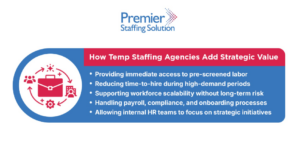
How Temp Staffing Agencies Add Strategic Value to Manufacturing
Temp staffing agencies now help manufacturers and warehouses by:
Why Manufacturers Are Relying More on Staffing Agencies
Manufacturers are relying more on staffing agencies because:
- Internal hiring teams cannot scale fast enough during surges.
- Workforce disruptions are becoming more frequent.
- Labor flexibility directly impacts profitability.
- Compliance and safety requirements are becoming more complex.
- Speed to productivity is critical in competitive markets.
These factors have accelerated the growth of industrial staffing services as a strategic operational function.
Industrial Staffing Services as a Competitive Advantage
The most successful industrial organizations are those that integrate staffing into their broader business strategy.
Strategic industrial staffing services help companies:
- Forecast workforce needs more accurately through proactive workforce planning.
- Align labor supply with production cycles
- Reduce downtime caused by staffing shortages
- Maintain service levels during disruption
- Control labor costs without sacrificing output
Organizations that adopt this approach gain a significant advantage in rapidly changing markets.
Conclusion: The Future of Industrial Staffing and Workforce Strategy
Industrial staffing is no longer a background HR activity. It is a strategic function that directly impacts productivity, profitability, and resilience.
PSS delivers comprehensive industrial staffing services, manufacturing staffing, warehouse temp staffing, and skilled trades staffing designed to help organizations stay productive, flexible, and competitive.
Contact PSS today to build a flexible workforce strategy prepared for the future of manufacturing and warehousing.
FAQ: Industrial Staffing Trends and Workforce Strategy
What is the future of industrial staffing?
The future of industrial staffing is flexible, technology-aware, and strategy-driven. Organizations will rely more on hybrid workforce models that blend permanent employees, temporary labor, and skilled trades staffing to manage uncertainty, respond to changing warehouse labor demand, and support long-term operational growth.