

In 2023, Premier Staffing had the privilege of supporting many great companies across multiple industries. From providing temporary staff for seasonal demand, recruiting specialized professionals for niche roles, or aiding permanent placements, we take pride in helping our clients achieve their goals. Increasingly, organizations turned to staff augmentation and flexible workforce models to navigate shifting labor demands and operational pressures.
Our “2023 Staffing by the Numbers” is a highlight of how we helped keep organizations running. Many of our placements for the year were emergency staffing solutions skilled and general workers who filled open roles during a critical time. In most markets, we can provide candidates within 24-72 hours, supporting companies that require immediate stabilization during workforce gaps.
Additionally, we are right sized to provide the flexibility and customized solutions many organizations need. Through contingent staffing, manufacturing staffing, and manufacturing temp staffing, we align deeply with client industries to deliver scalable workforce solutions. In 2023, we also expanded our staffing services beyond the United States to Canada and Mexico, further strengthening our labor market outlook and cross-border capabilities.
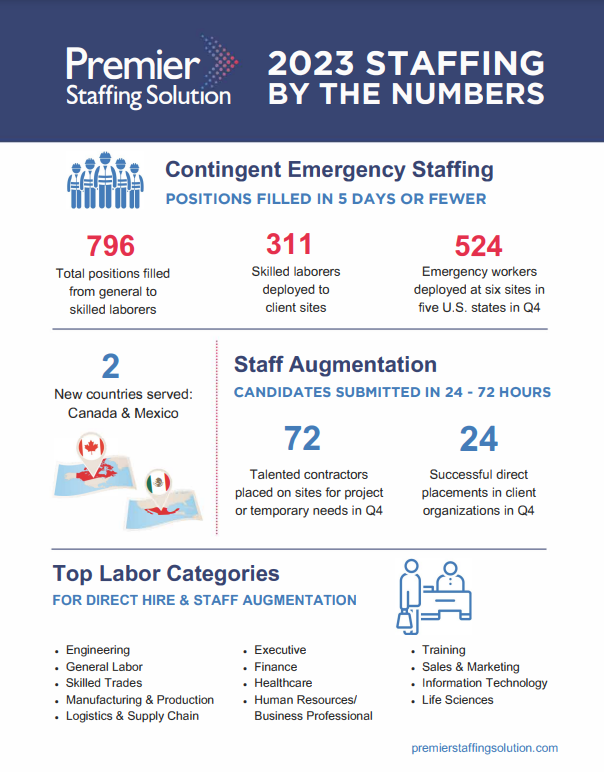
2023 Staffing by the Numbers: Emergency Staffing, Manufacturing Staffing, and Workforce Impact
Success in not only in the only of placements we make but also in the impact we have on the businesses we support. When our clients can operate smoothly with the workforce they need, it is a testament to the effectiveness of our solutions and our people, and the strength of our partnerships. Whether supporting warehouse temp staffing, assisting with direct placements for leadership roles, or deploying automotive staffing professionals for production continuity, our solutions are designed to keep operations steady.
We understand the importance of having reliable talent to meet our clients’ diverse needs. By continuously sourcing and vetting top candidates, while also nurturing our talented labor pool, we ensure that we can match the right candidates with the right companies to foster mutually beneficial relationships. We aim to build relationships and become a trusted partner and resource.
Looking Ahead: 2024 Staffing Trends and Workforce Planning Strategy
In 2024, recruiting and retaining top talent will remain a challenge for many organizations. In fact, according to a survey by Chief Executive magazine, just behind inflation pressures (59%), CEOs named engaging and retaining employees as their number two challenge (41%) and recruiting for open positions as the third most pressing challenge (40%) for 2024.
This labor market outlook signals a growing reliance on staff augmentation and contingent staffing as organizations seek flexibility without sacrificing performance. Companies across manufacturing, logistics, and automotive sectors are shifting toward scalable workforce solutions that allow them to respond quickly to market fluctuations.
In 2024 staffing trends, we anticipate:
- Continued expansion of staff augmentation programs
- Increased demand for manufacturing temp staffing
- Greater reliance on emergency staffing for rapid gap coverage
- Strategic use of direct placements for leadership stability
- Rising adoption of warehouse temp staffing in distribution networks
If you could use a boost this year, we are standing by ready to help with top talent on our bench and veteran recruiters at the ready to fill your openings.
{{cta(‘5ed272fe-b87b-44f1-b4f6-30201543cf0f’,’justifycenter’)}}
Can we help fill your open positions? Contact us to get started.
Why Staff Augmentation Will Define 2024 Staffing Trends
As workforce volatility continues, staff augmentation is evolving from a tactical hiring solution into a strategic growth driver. Organizations are recognizing that rigid hiring models create vulnerability during economic shifts, expansion cycles, and supply chain disruptions.
Staff augmentation enables companies to supplement internal teams with specialized professionals for defined periods or projects. This approach supports manufacturing staffing, automotive staffing, and warehouse operations without inflating long-term labor costs. Instead of overcommitting to permanent hires, businesses can scale up or down in alignment with demand cycles.
In manufacturing and logistics sectors, the combination of manufacturing temp staffing and warehouse temp staffing ensures production continuity during seasonal surges or unexpected labor shortages. Emergency staffing remains critical in high-volume environments where downtime translates directly into revenue loss.
Moreover, contingent staffing models allow organizations to test new market initiatives or production lines before committing to permanent structural changes. When aligned with a clear workforce planning strategy, staff augmentation reduces risk, enhances agility, and strengthens competitive positioning.
As part of 2024 staffing trends, companies will increasingly blend contingent staffing with direct placements to create hybrid workforce models—balancing flexibility with stability.
Balancing Contingent Staffing and Direct Placements for Sustainable Growth
A key theme in the labor market outlook for 2024 is balance. While flexibility remains essential, long-term stability cannot be overlooked. That is where the integration of contingent staffing and direct placements becomes critical.
Contingent staffing provides immediate workforce elasticity, allowing organizations to respond to fluctuating workloads, expansion efforts, or restructuring initiatives. This is particularly valuable in manufacturing staffing environments where production cycles can shift rapidly.
At the same time, direct placements secure leadership continuity and institutional knowledge. For automotive staffing and industrial operations, permanent technical and supervisory roles ensure operational consistency while augmented teams provide support.
This blended approach enables companies to implement scalable workforce solutions. Rather than reacting to workforce shortages with emergency hiring alone, organizations can plan proactively—combining staff augmentation with targeted long-term recruitment.
When executed strategically, this hybrid model reduces turnover risk, improves morale, and enhances productivity. As 2024 staffing trends continue to evolve, organizations that adopt integrated workforce strategies will outperform those relying on traditional hiring alone.
FAQs: Staff Augmentation, Contingent Staffing, and 2024 Workforce Trends
1. What is staff augmentation and why is it growing in 2024?
Staff augmentation is a workforce strategy that allows companies to add skilled professionals to their teams on a temporary or project basis. It is growing in 2024 because organizations need flexibility amid economic uncertainty, talent shortages, and evolving production demands. By leveraging staff augmentation, businesses can scale operations efficiently without long-term financial commitments.
2. How does contingent staffing differ from manufacturing temp staffing?
Contingent staffing is a broader workforce model that includes temporary, contract, and project-based roles across industries. Manufacturing temp staffing specifically focuses on production and industrial roles. Both support scalability, but manufacturing temp staffing targets operational continuity in plant environments.
3. When should businesses use emergency staffing solutions?
Emergency staffing is best used during unexpected absences, labor disruptions, or sudden production surges. It ensures operational continuity while leadership evaluates longer-term workforce adjustments.
4. How do direct placements support long-term workforce strategy?
Direct placements secure permanent talent for critical leadership or technical roles. When combined with staff augmentation and contingent staffing, they create a balanced workforce model that supports both flexibility and long-term stability.
PSS cannot and does not provide legal advice. It’s important to consult with qualified counsel before adopting any new policies. It’s also your responsibility to determine whether legal review of work product is necessary prior to implementation.